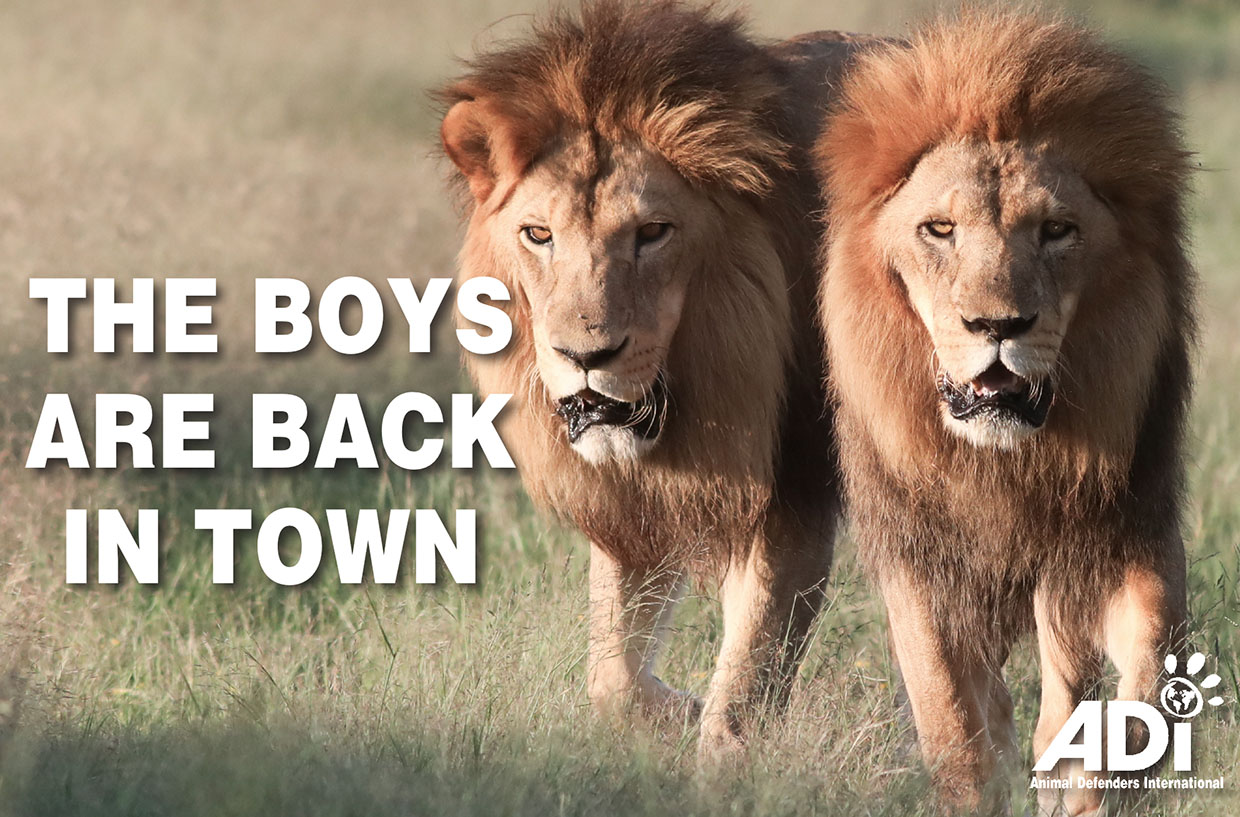
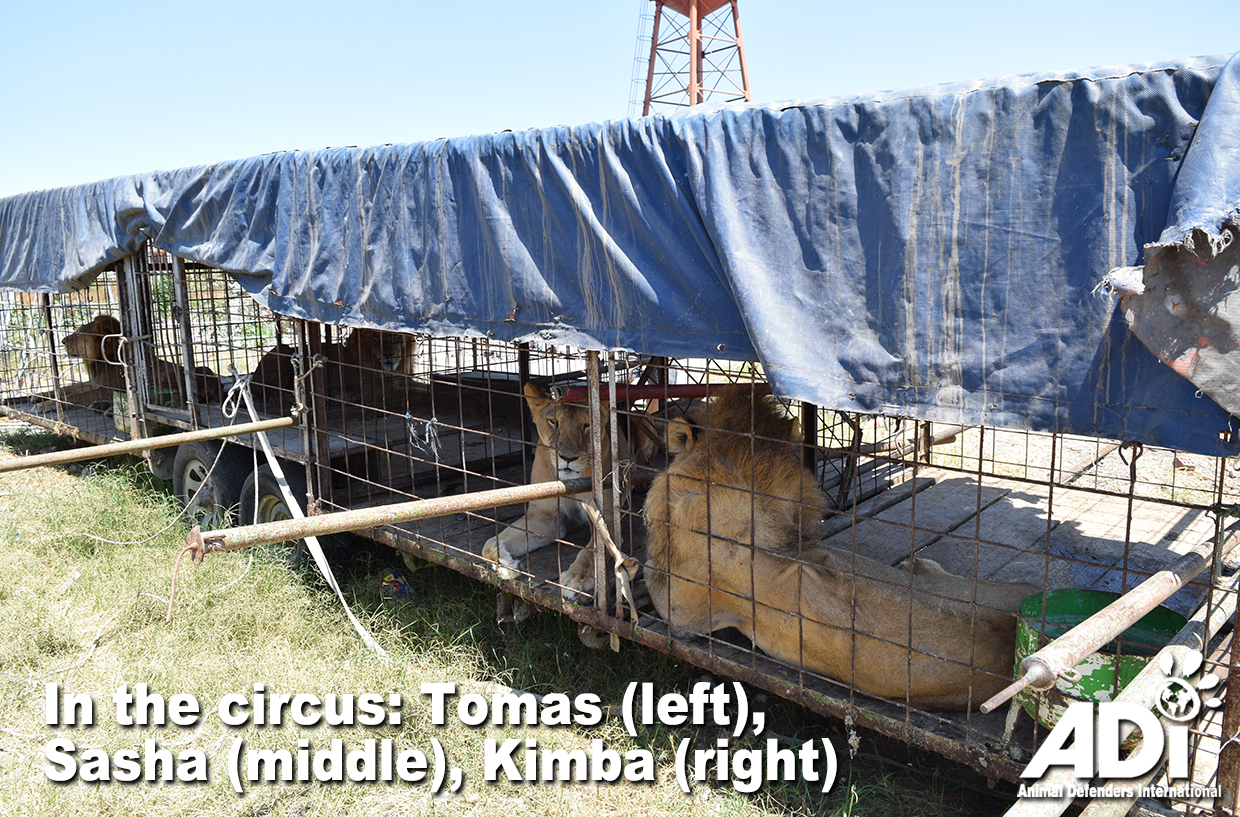
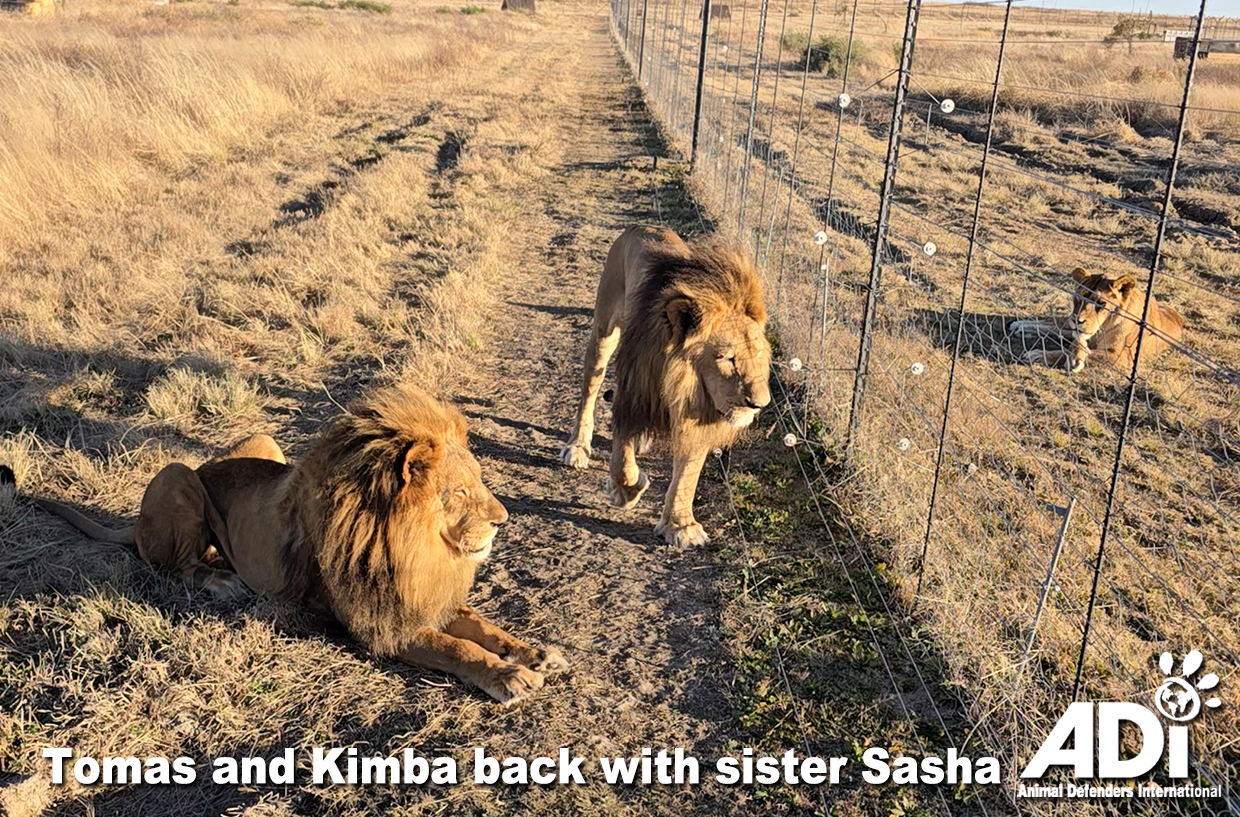
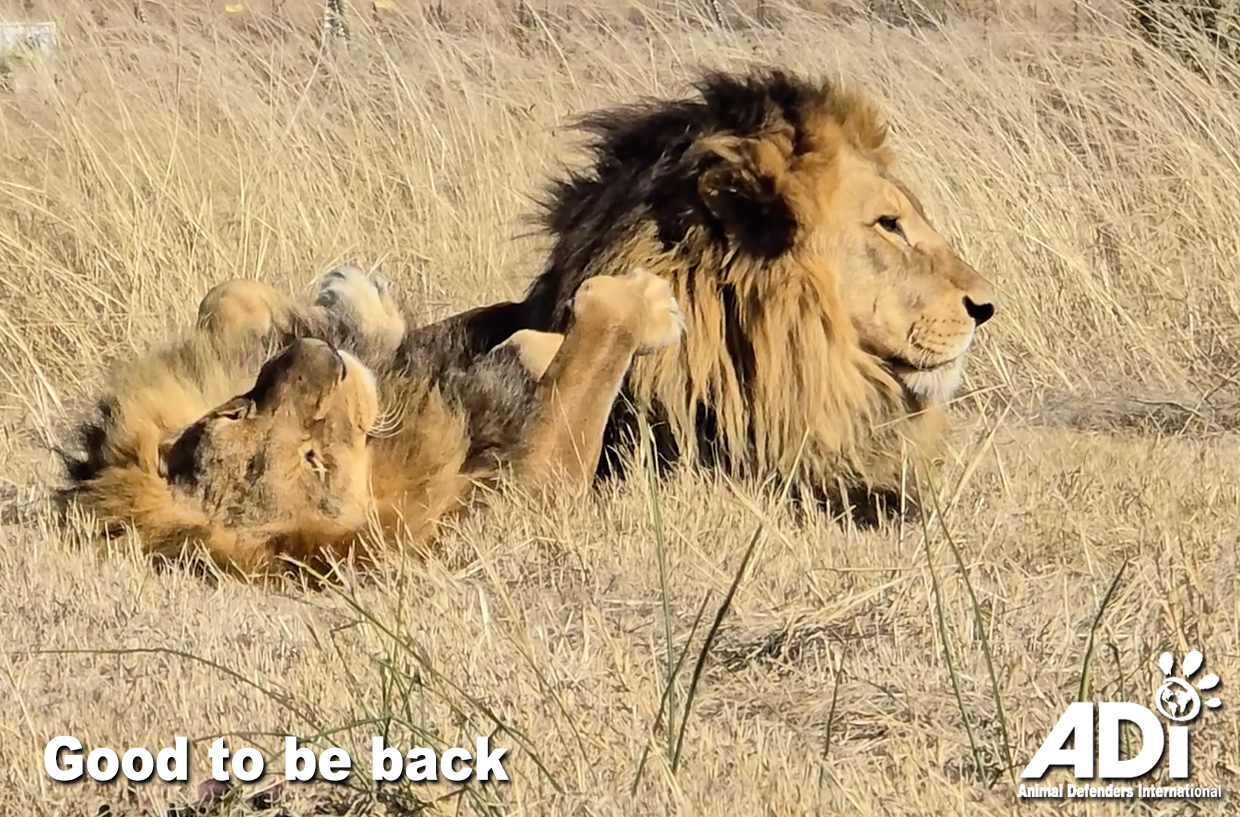
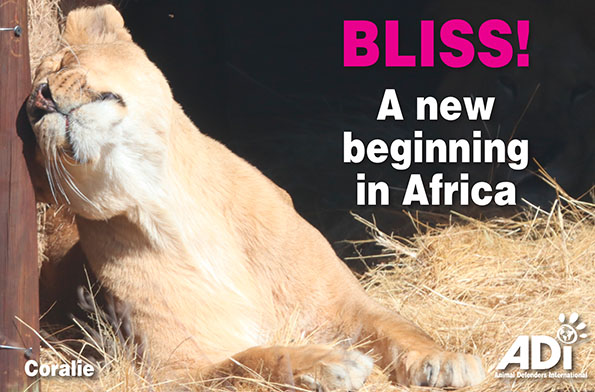
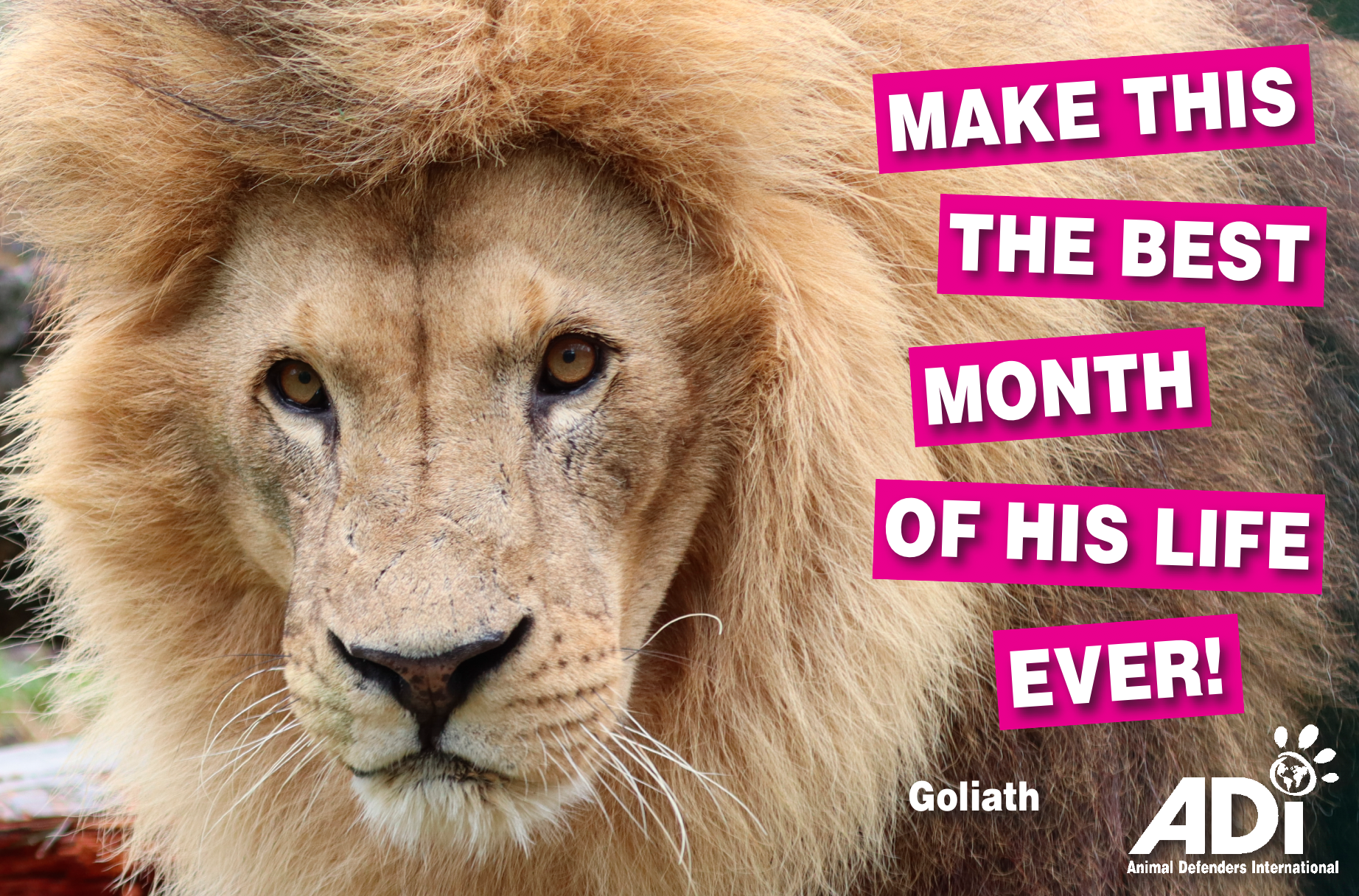
This week, rescued French circus lions Goliath and Coralie stepped onto the land of their ancestors and began their new lives at the ADI Wildlife Sanctuary, South Africa. They spent the first decade of their lives in a tiny circus cage, now they will enjoy the rest of their lives roaming the land, running at full speed, playing in the grass, and napping under the African skies .
GREAT NEWS: French circus lions Coralie and Goliath fly to their new life on Tuesday!
Our preparations intensified this week after Qatar Airways Cargo generously offered us free passage on flights to South Africa. Tomorrow, Tim and I fly to Lyon where we will meet ADI veterinarian Dr Peter Caldwell – the three of us will be with the lions throughout the journey.
We will be checking in on Goliath and Coralie at Tonga Terre d’Accueil on Sunday and then on Monday evening at 7.30pm the lions will be sedated and loaded into their travel crates. At 9pm we will set off on a 7-hour drive to Paris Charles de Gaulle Airport – as you will know from previous rescues we must be at the airport with the animals 8 hours before the flight. We will be taking off at 4.55pm on Tuesday to fly to Doha arriving around midnight where we will be for four hours. We change aircraft in Doha and depart at 4am on Wednesday morning and finally arrive in Johannesburg at 11.35am.
We expect to get to the ADI Wildlife Sanctuary shortly before sunset and so will let the animals into their house where we can assess them before releasing them for their first steps on African soil on Thursday 22 May.
At the Sanctuary, I am delighted to report that this week we moved Sasha Tiger into her new house and habitat, so she is now much closer to her relatives. Sasha’s old habitat (Stephi) is being converted into the ADI Wildlife Sanctuary Quarantine unit. This already has a two-room house, two feeding camps and a 2.5 acre main habitat. We are currently adding a washroom, storage for tools (only used in quarantine), footbaths, drive through disinfectant baths for vehicles and waste disposal. Big cats arriving at ADIWS will initially be held here in future – Goliath and Coralie will be the first.
We also couldn’t help but notice Goliath’s joy as he bounced on his trampoline at Tonga Terre d’Accueil (see pic)! Our team has been creating our own version using heavy duty conveyor belt rubber. We wouldn’t want him to feel he was missing out!
These two intelligent, beautiful, lions have suffered a lifetime of deprivation and abuse, living in a tiny cage, bare floorboards, behind bars, with no regard given to their wellbeing or physical needs. No freedom of movement, no space to roam. Now, thanks in great part to your generous donations, Coralie and Goliath will soon be on their way to freedom. At the Sanctuary, they will enjoy life and as close as possible to what nature intended.
This rescue marks another landmark in ADI’s global Stop Circus Suffering campaign that has seen over 50 countries and seven states in the USA (the most recent is Washington State) ban the use of wild animals in circuses. It began with us going undercover and exposing the suffering, our campaigns and now we are emptying the cages. ADI supporters like you made this possible.
It is the beginning of the end for wild animals in circuses in France. A full ban on wild animal acts comes into force in 2028, and in the meantime the new regulations phasing out these cruel acts enabled Coralie and Goliath to be removed from a circus following an investigation by our friends at Free Life Association. Coralie and Goliath were taken into care at Tonga Terre d’Accueil, a temporary holding centre for confiscated animals near Lyon and that is where their journey to a new life will begin on Monday.
We hope to be doing live updates during the rescue on different platforms:
We are so very grateful to everyone who has helped get us this far, and to Qatar Airways Cargo who previously donated the flights for Ruben and the Kuwait 6 lions (and were the airline we used to fly the 17 tigers and lions from Guatemala). Unfortunately, we are still a long way off our fundraising target to cover the costs of caring for Coralie and Goliath for the next ten years, the preparations and building at the ADI Wildlife Sanctuary and all of the costs related to the relocation such as ground transport. I hope that you will consider helping as these two lions, who suffered so much, approach the finish line.
Ten years ago, ADI supporters like you helped one of our most ambitious building projects – a complex of monkey habitats in the Peruvian rainforest at the Pilpintuwasi Wildlife Rescue Center, providing a home for dozens of monkeys, like Pepe and Valerie, saved from horrific abuse. A home in their natural jungle environment.
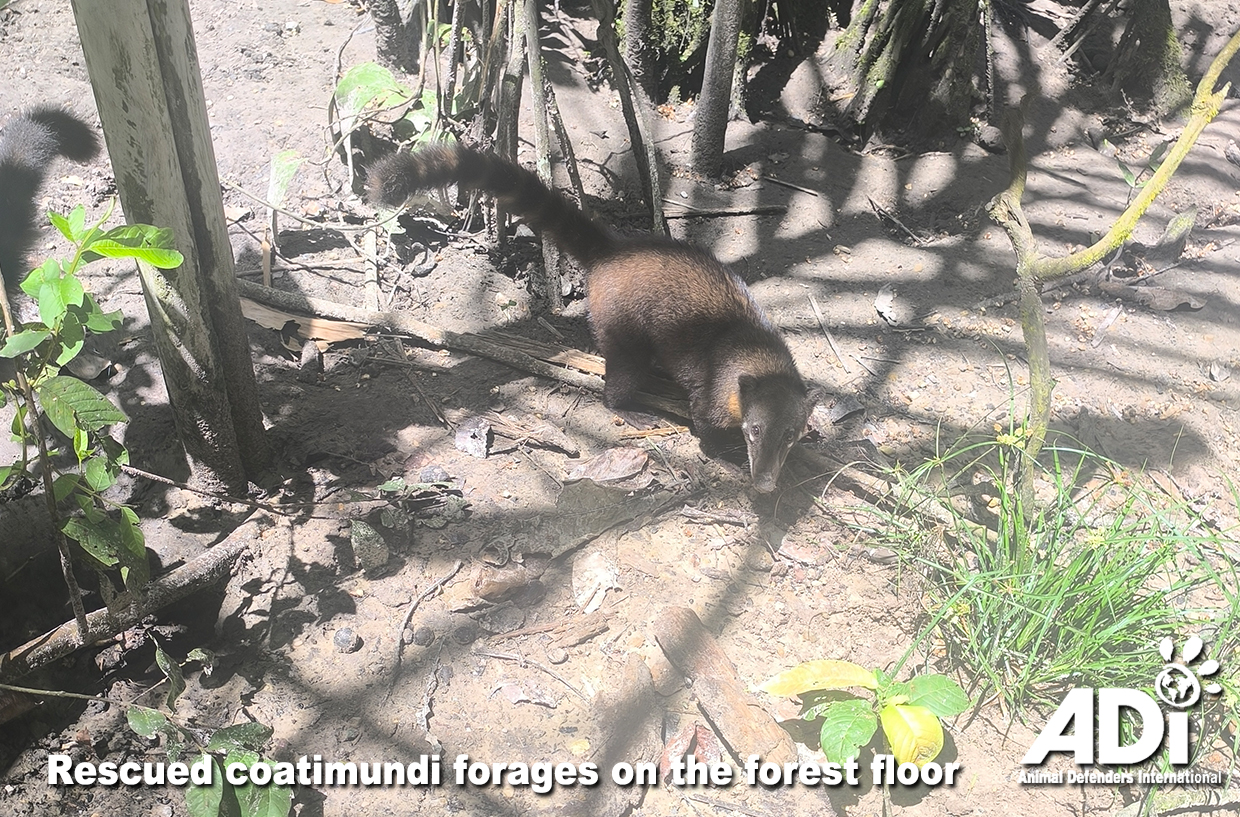
We worked in sweltering heat and pouring rain and found ways to build around trees and across streams, but it was worth it, as all of the different species of monkeys plus kinkajous and coatimundis bounded from their travel crates. We continue to fund their care and the others who have since joined them.
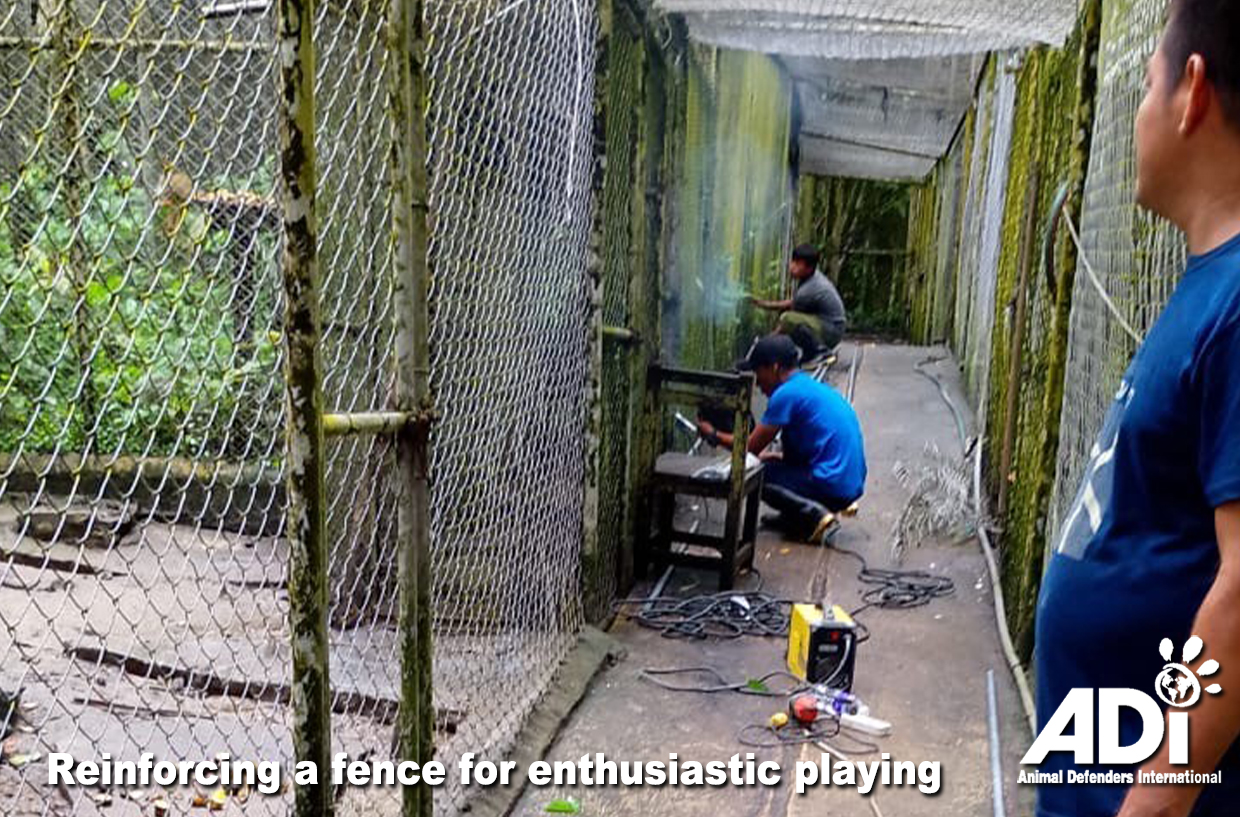
Recently, I reached out to you about some important repairs to these jungle habitats. Ten years of enthusiastic monkeys swinging through the trees at great speeds, leaping onto houses and landing with force, and testing habitat fencing – plus wear and tear from the rainforest environment – have taken a toll.
Thanks to your generous donations, work is underway, and I wanted to share an update! We purchased all of the materials – rolls of mesh, metal poles, concrete, wire, and wood – and transported them up the river. We are underway! Thank you.
However, there is still much to do, and we are only halfway towards our fundraising target. I hope you will consider a donation today to help us continue taking care of residents rescued from circuses, restaurants, the pet trade, and traffickers.
Saved from lives where they were chained up, alone, and often mutilated by having their teeth broken off, they could never go back to the wild. Our sanctuary habitats in the rainforest gave them a lifeline and a chance to live as close to what nature intended as possible.
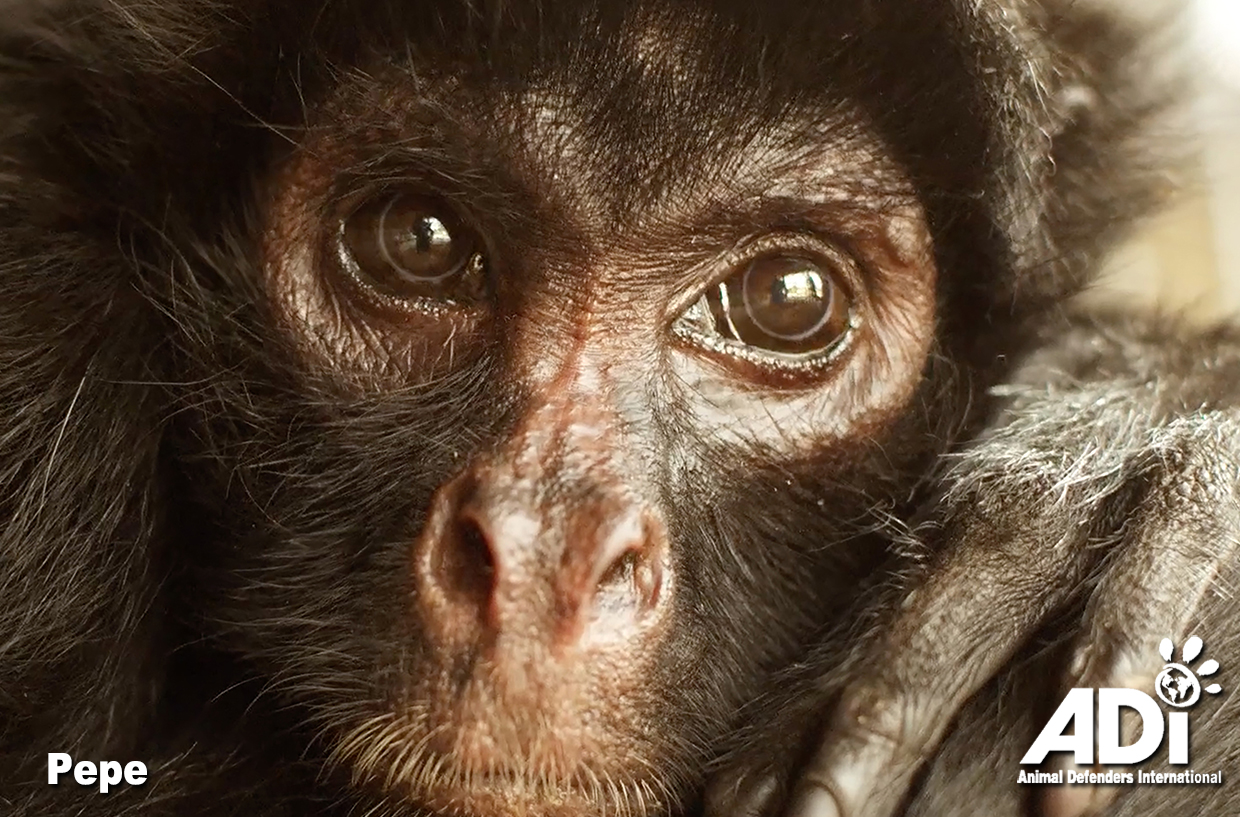
Pepe symbolizes so many of these survivors. Chained alone in a circus for eight years until ADI cut him free. We reunited him with his own kind – I’ll never forget that first magical meeting with Valerie when he called out with joy! Then we took him home to the forest. Check out this new video from Geo Beats telling his story. Check out this new video from Geo Beats telling his story.
As Pepe approaches his 20th birthday, what better way to celebrate than by completing the renovations to his cherished home? With your donation, we can give Pepe, and indeed all of the monkeys, a gift that he will truly enjoy for years to come!
I do appreciate that we are also asking for your help to save lions Goliath and Coralie, that is the nature of working on multiple fronts for animals and needing to care for these animals for life. If you can spare something, any help for our monkeys in the forest will be appreciated.
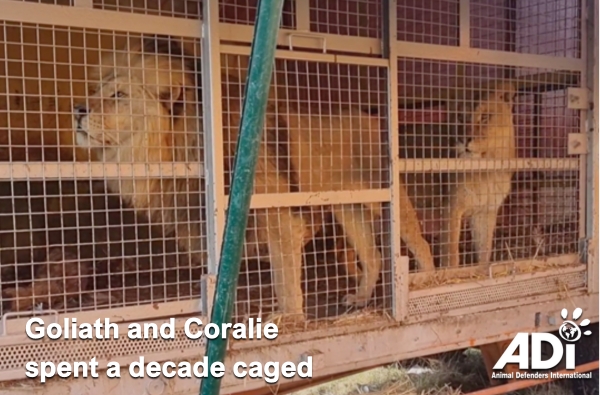
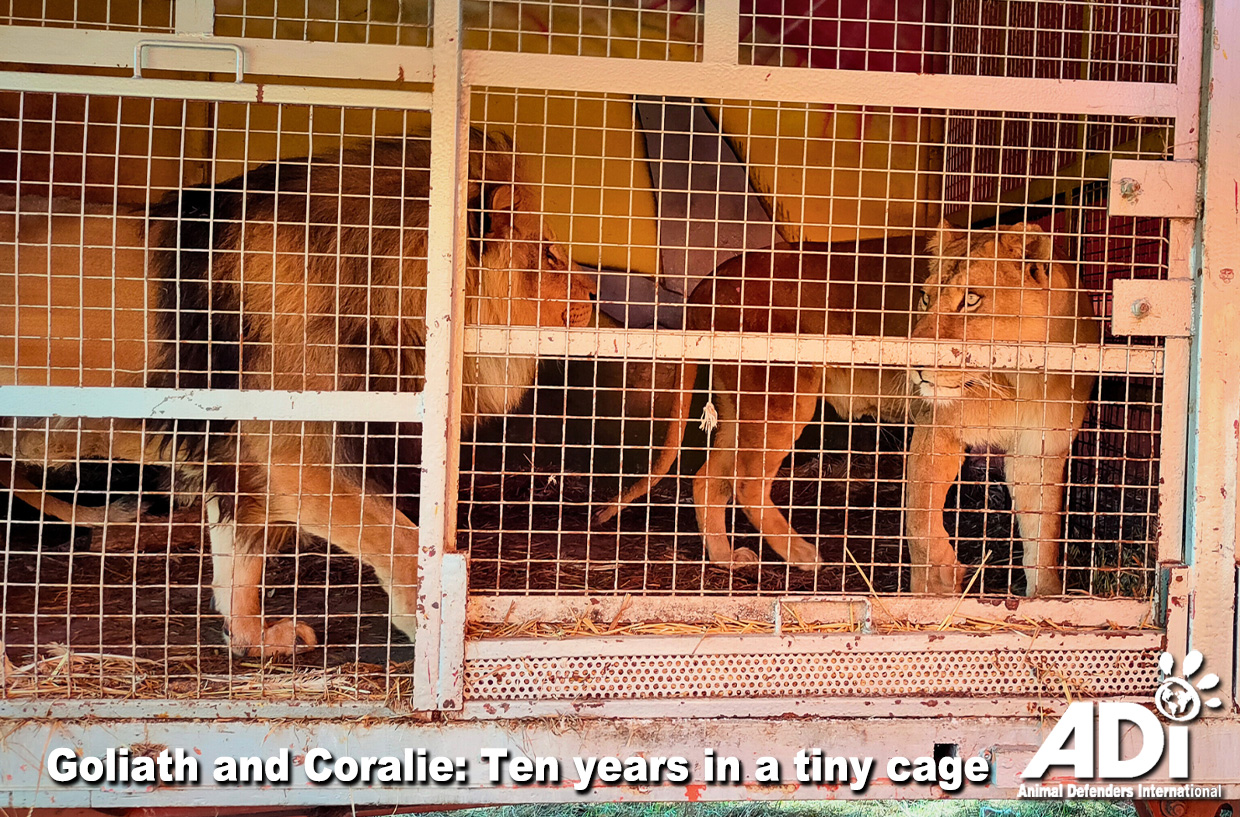
Coralie and Goliath spent their first decade in a tiny, rusting cage on the back of a truck, sleeping on bare boards – prisoners of Cirque Idéal in France.
With your help these doting lions could be starting a new life at the ADI Wildlife Sanctuary, South Africa, THIS MONTH!
In circuses, animals are confined in small spaces, in cages the size of a queen-size bed. They would never run, explore, or play. Never have the sun over their head. A brutal life of deprivation, lack of space. They had no access to life on the other side of their bars. Deprived of everything that makes life worth living.
As we know, circuses cannot meet the physical or behavioral needs of wild animals. They are often seen behaving abnormally – rocking, swaying, and pacing, all indicating they are in distress and not coping with their environment. This was the life that Coralie and Goliath were living.
After France passed a law in 2021 phasing out animal circuses, Coralie and Goliath were removed from Cirque Idéal, following an investigation and ADI was asked to provide a forever home. Tim and I immediately said yes! This was a chance for us to return these wonderful lions to the land of their ancestors, in the African sun where they belong.
Coralie and Goliath are currently being kept at a temporary holding center in France as we work to get their flights scheduled. We have secured the permits to move them to their new home, and – thanks to your generous support – we have raised enough money to build their crates, which cost $5,500 / £4,200 each.
But we are still a long way off our fundraising target to cover the costs of a mission like this. We hope to be flying them before the end of the month, will you help make that happen?
There’s always a lot to do to prepare for a new arrival. The new house is nearing completion and habitat landscaping is underway with three pools and more for tiger Sasha. Her current habitat will become our main quarantine unit for new arrivals. This quarantine space will provide Coralie and Goliath – and future rescued animals – with about 2.5 acres of space to run and play. These renovations have added to the cost of getting our new lions back home.
Coralie and Goliath have lived together all their lives and are a close, affectionate pair. They may remind you of our dear Tanya and Tarzan, who have enjoyed life at the Sanctuary since 2020, after we rescued them from a circus in Guatemala. Just like these two, Coralie and Goliath will be able to enjoy the rest of their lives free from suffering at the hands of humans.
This rescue will transform the lives of Coralie and Goliath and is an important step towards eliminating all wild animals in French circuses by 2028. ADI is ready to help move this ban along quickly, as we’ve done many times in other countries. This starts by getting Coralie and Goliath to their new home in South Africa. Can you help change their lives forever?
As we approach the Easter holidays and World Day for Laboratory Animals (April 24), I’d like to share with you the latest news from ADI including another US State passing a ban on wild animals in circuses, a circus rescue in France, state bans on bullfighting rippling across Mexico, and what could potentially be one of the biggest breakthroughs on animal experiments for years.
In what could be one of the most important breakthroughs towards ending animal testing, the U.S. Food and Drug Administration (FDA) has announced a ‘Roadmap to reducing animal testing in preclinical safety studies’, saying there is “..growing recognition that animals do not provide adequate models of human health and disease” and “over 90% of drugs that appear safe and effective in animals do not go on to receive FDA approval in humans”. Announcing that “new approach methodologies” (NAMs) are “more effective, human-relevant models” and the new strategy can “accelerate the validation and adoption of …human-relevant methods”. The roadmap is a statement of intent – we must ensure that it is followed through.
Passing the House with a massive majority (65-32), bill SB 5065 will ban traveling acts from touring with elephants, big cats, primates, bears, and hybrids of these species across Washington State. The bill now moves to the Governor’s desk for signature. If you live in the state, please urge Gov. Ferguson to sign SB 5065 into law – call 360-902-4111 or send a message here (making sure to leave your name and address to verify residency).
In addition to the new ADI Wildlife Sanctuary grey water recycling and waste disposal systems which are under construction, we have boosted our supply of drinking water with three new boreholes. Drilled to depths from 40m/131ft to 60m/196ft you can see the one pictured here hitting water! This will help safeguard our future and enable us to save more animals.
Michoacán joined Sinaloa, Sonora, Coahuila, Quintana Roo, and Guerrero, to become the sixth of Mexico’s 31 states with a bullfighting ban. Mexico City has outlawed the use of weapons that injure the bulls, making it a bloodless spectacle, but still one that terrorizes the bulls. ADI Latin America, a member of the “México Sin Toreo” (Mexico Without Bullfighting) Movement, will continue to fight for its abolition nationwide. We are also working on a new campaign in Peru following Colombia’s successful ban on bullfighting.
The Bay Area Renaissance Festival in Dade City, Florida invited Lauryn Murray back again this year to host elephant rides. ADI undercover investigations have documented training of elephants for rides which has included beatings and electric shocks to ensure the animals are compliant in public. The festival is over this year, but please send a polite message to the Bay Area Renaissance Festival, urging them to no longer host elephant rides: info@bayarearenfest.com.
The ADIWS on site team has moved into the first section of the Tohir Staff Village and the final phase is almost finished. Once complete, it will house 15 of our team at the heart of the Sanctuary. On duty 24/7 to look after the animals and deal with any emergencies. Each team member has their own room with bathroom, with common areas including two kitchens, laundry room, a TV room, and a games room. Thank you to everyone who supported this important investment in the future of the Sanctuary and the welfare of the animals.
Sponsored by Congressman Don Beyer, the Humane Cosmetics Act (HR1657) has been reintroduced! The Act would make it illegal to conduct or contract for animal testing for cosmetic products in the US and prohibit the sale or transport of cosmetics developed or manufactured using animal testing. ADI investigations have exposed suffering of animals in cosmetic testing, including racks of rabbits restrained in stocks, and guinea pigs suffering raw, inflamed skin lesions. Help get the Humane Cosmetics Act (HR1657) passed to restrict. Take action here
Abbey Stadium in Swindon is to close at the end of this year after 73 years. Costs for staging dog racing have increased rapidly, and keeping the stadium operating is said to be no longer viable – indicating falling public support. Greyhound racing causes fatal injuries to dogs and life as a racing dog is short – ADI hopes England and Scotland will follow Wales’ lead and ban this cruel sport.
The California Authority of Racing Fairs has cancelled all 2025 horse racing events in Northern California. Horses however continue to suffer and die on other racing tracks, with nearly 700 horses dying in the US alone last year. If you live near a racecourse and are organising a protest, let us know at USA@ad-international.org and we can help promote.
In the UK, horse Willy De Houelle died after a horror fall on the first day of the Grand National Festival at Aintree, with another horse, Celebre d’Allen, later dying after collapsing near the finish line. At the subsequent Scottish Grand National, Macdermott and The Kniphand also died. Horses are dying in the name of entertainment and it’s time it ended.
It can be tough, dirty work at ADIWS, preparing food, giving meds, cleaning animal houses and habitats, cutting grass, planting trees, and more. Work continues whatever the weather and in Africa that can mean torrential rain and serious heat, so our team needs practical clothing. We were therefore incredibly grateful to Jonsson Workwear, who donated new uniforms for the ADIWS team and especially for much needed wet and cold weather clothing. It felt like Christmas came early when the boxes of clothing arrived and the boxes were turned into toys for the lions and tigers.
Meta acted after calls by ADI and other members of the Social Media Animal Cruelty Coalition to remove two monkey cruelty Facebook pages. Shockingly, one of the pages had been awarded a ‘Creator Badge’, which promotes and incentivises engagement. Meta’s existing policies explicitly prohibit content that depicts animal cruelty, yet enforcement remains inconsistent, and despite reports being sent to Meta, these sickening pages had remained up. Online cruelty is an ongoing issue and ADI with SMACC are calling for a full review of Facebook’s content moderation management system, full transparency on abusive content continuing to generate profit and how to stop it.
The India Shrine Circus invited Hamid Circus to bring Carson & Barnes elephants to Oklahoma City, in violation of the Oklahoma City Code prohibiting animal performances, or exhibitions where animals are encouraged, forced, or trained to perform. Please speak out and urge the Greater OKC Chamber to ensure the circus does not return with animals in future – email econdev@okcchamber.com and/or call the Chamber on (405)297-8900.
David was heartbroken after Easy passed away last year. He retreated into himself, barely leaving his feeding camp at the Sanctuary. Grief protocols, used to help the animals through loss, were implemented with Resident Welfare team member Eleanor giving extra enrichment and spending quiet time with him. It is good to now see him exploring his habitat again. We put David with Easy after she lost her sister Shakira, and he adored the older lioness, who was very much the boss. We were all devastated when Easy succumbed to cancer, leaving poor David alone again. We will continue to look for a companion for David. It is always a challenge introducing powerful animals like lions, but the extra risk for David is that he was ‘declawed’ (front toes partially cut off) in the circus, making it risky to put him with a female with claws.
ADI joined activists outside the Los Angeles Zoo to call for sanctuary for elephants Billy and Tina. Elephants need vast amounts of space and complex social structures to remain physically and psychologically healthy. Like so many others, Billy and Tina have been condemned to a life of solitude and confinement for decades. It’s time for the zoo to do the right thing and release them to a sanctuary. Join our call and contact CEO & Zoo Director Denise Verret on (323) 644-4200 or email membership@lazoo.org.
King’s Lynn & West Norfolk Borough Council rejected plans to demolish existing buildings and build new units to expand housing on-site to 14,000 pigs and 714,000 chickens in Norfolk. Producers Cranswick, who were behind the application, failed to demonstrate the development would not cause ‘significant adverse effects’ and failed to provide sufficient environmental information, despite having had 3 years to do so. In its submission of opposition, ADI outlined the negative effects the proposal would have on public health, climate, environment, animal welfare, and local residents. Over 12,000 objections were lodged. A victory for common sense, we hope the decision of the council will stand and not be appealed.
It is a decade next week since our epic relocation of 39 monkeys, coatis and kinkajous, saved from circuses and the pet trade in Peru, including Pepe and friends. It was a 15-hour journey by road, air, and river. Back to the jungle with their own kind, the animals formed family groups. Talking the same language, they were no longer alone. ADI has continued to fund the care and housing for our rescues at Pilpintuwasi ever since. We are now undertaking major repairs and replacements. To help with urgent improvements and repairs: Donate US $, CA $ I Donate UK £, Euros, Rand We are nearly halfway to our target – can you help us get over the finish line?
Check out this aerial view of some of the habitats at the ADI Wildlife Sanctuary. You’ll see Kiara and Scarc, Rey Cusco, horses Crockett with mom Amani grazing between habitats, cow Matilda, Smith looking up from his platform, Africa and Kiara on the feeding camp platform and Rolex amongst the trees, Saham in the feeding camp, and David on the move.
Coralie and Goliath spent a decade in this circus cage. They now have a chance to spend the next ten years at ADIWS. In 2021, France passed a law phasing out wild animals in traveling circuses, first prohibiting breeding wild animals in circuses and setting minimum welfare standards, with the full ban coming into force in 2028. Removed from Cirque Idéal, following an investigation by Free Life, Coralie and Goliath are being cared for at Tonga Terre D’Accueil, a temporary holding facility for confiscated animals near Lyon. ADI has secured permits from France and South Africa, and are looking for flights, and building at the Sanctuary. We urgently need funds for the care of the relocation and care of these animals: Donate US $, CA $ | Donate UK £, Euros, Rand
Let’s start with some great news: This week, Washington State’s ban on traveling shows with elephants, big cats, non-human primates, bears and hybrids of these species, passed with a massive majority – 65-32! The ban now moves to the Governor’s desk for signature.
Thanks to relentless campaigning, we are continuing to make progress. More than 50 countries now have bans and where possible, wherever we can, ADI will be there to empty the cages – saving the animals and maintaining the momentum for others to pass bans.
This is why our latest rescue of Goliath and Coralie in France is so important.
France, which, when we started with the first undercover investigations had one of the largest and most established circus industries in the world, recently passed their law phasing out wild animals in traveling circuses by 2028. The phaseout started with regulations to end breeding and set welfare standards.
With your support, ADI can help make this ban work as we have done elsewhere, by rehoming the animals – starting with two wonderful lions Coralie (13 years) and Goliath (11 years).
These circus survivors have been removed from Cirque Idéal and are being cared for in the Tonga Terre D’Accueil, a temporary holding facility near Lyon, which takes in confiscated animals until a permanent home is found. With your help, that will be the ADI Wildlife Sanctuary, South Africa for Goliath and Coralie.
Goliath and Coralie endured their first decade in a tiny stinking, circus cage. If we all pull together, their next decade will be in the African sunshine, in their native homeland.
Huge thanks to everyone who responded to my call for help last week. We have raised enough for their new travel crates, and these are being built in France. I am also pleased to confirm that our permits to move the lions have been approved by France and South Africa.
And we are making their space at ADIWS at top speed! We need to move around some residents to make Goliath and Coralie’s patch of African heaven:
First up: The new Alexis Habitat, we are building the house, fitting out the internal rooms, building the outside viewing platforms with dens underneath, and pools, for Sasha tiger. She can then move closer to her relatives – Sun, Moon, Luna, Lupe, Max and Stripes.
Second: Sasha’s old habitat will be converted into a quarantine unit to receive Goliath and Coralie. They will have 2.5 acres with pools and viewing platforms and dens, and the bottom half of the habitat (which they will access after initial quarantine and orientation) has a natural spring running through it. Our current quarantine units are still occupied by the Kuwait lions, who need to stay in there for a while longer. All of this is a major expansion for the ADIWS, but if we are to save more animals, we must press on.
That said, for Goliath and Coralie, we have a way to go yet. I am speaking to cargo companies about flights, we will need road transport and handling arrangements at the airports. However, as you know, the biggest challenge is raising enough funds to cover food, care, and veterinary treatment for the rest of their lives.
I love how these animals rescued from such deprivation, suffering and abuse, embrace life when given the chance. As Tim and I watched them in France, Goliath rolled on his rubber bed with his legs in the air, like a kitten. Coralie joined in, they played with bowling skittles, climbed on logs, enjoyed the fun in life they had missed for the first half of their lives.
Why not adopt these fun loving lions today and follow their incredible journey over the coming years? UK store I US store
Can you imagine how much they will enjoy the acres of space and treats and surprises that ADIWS has to offer? The small wildlife running across their habitat – ground squirrels, rabbits, hares, mongooses, birds flying overhead, the sounds of the wild. You can make that happen for them.
This rescue is a huge step towards eliminating wild animals in circuses in France, forever. We can show government officials that circus bans can be a success. If this move is successful, we hope to help with more animals from the circuses, emptying more cages and bringing the day closer when no animals will suffer like Coralie and Goliath, ever again.
I do hope that you can help with this rescue, for Coralie and Goliath AND the animals still in the circuses, whose chance to be free has not yet come. Let’s empty these cages ahead of the 2028 deadline. Donate UK (£, Euros, Rand) I Donate US $, CA $
ADI has been asked to provide a forever home for lions 13-year-old Coralie and 11-year old Goliath, who have escaped the circus following France’s ban on wild animal acts in circuses in 2021. The law has phased out the animal circuses with stopping breeding, setting of welfare standards, and the full ban is set to take effect in 2028.
Of course, we said yes! Tim and I went to visit Coralie and Goliath to finalise the agreement to bring them home to the ADI Wildlife Sanctuary, South Africa. The couple have lived together all their lives and are close, affectionate, and remind us very much of our dear Tarzan and Tanya from Guatemala (like Coralie, Tanya is also a little older than Tarzan).
Coralie and Goliath were removed from Cirque Idéal in France, following an investigation by our colleagues from the Free Life Association, which exposed how they were confined to a tiny, rusting cage on the back of a truck. A complaint was filed with the authorities, but the circus left town and disappeared – a familiar story for ADI, as we have often had to pursue circuses for months! Then a stroke of luck; a town hall contacted Free Life, saying the circus had been on their land for several months and was refusing to leave. The other lions were removed and given a temporary space in a zoo, but Coralie and Goliath could not be homed – it was claimed that Goliath was aggressive, but when Tim and I met him, we found him to be a peaceful, playful soul.
Goliath and Coralie were taken to Tonga Terre D’Accueil, a temporary holding centre for confiscated wildlife established in 2007 which is funded/attached to a zoo, Espace Zoologique de Saint-Martin-la-Plaine. Their first rescue was a hippopotamus confiscated from a circus, (coincidentally, one that Tim and I worked to free through a court case in the noughties) and they have since housed and relocated over 500 wild animals rescued from cruelty cases, or confiscated from traffickers, or illegal exotic pets. But it is not a permanent home – Coralie and Goliath cannot stay there.
After a long process to get permission from the wildlife and veterinary officials in France and South Africa, we have our permits and are looking for flights!
Now, let’s get them home!
We need help – we must build new crates for Goliath and Coralie (on our last rescue we shipped two old crates flat-packed, but it was not as economic as we hoped). The new crates will be built in France (to international transport specifications) at a cost of €5,000 / $5,500 / £4,200 each. Other transport costs will include trucks to and from the airports in France and South Africa; customs and ground charges. We hope to get a free flight, or a concession on flight costs for both the lions and for Tim and myself to accompany them. We will keep you updated!
Meanwhile at the ADI Wildlife Sanctuary….
We are busy building a new tiger house so that Sasha tiger can move out of Stephi Habitat to our new Alexis Habitat, opposite her family (Max, Stripes, Lupe, Luna, Sun, Moon).
Then, Stephi Habitat will be converted to our first permanent quarantine unit, initially for Coralie and Goliath and then other animals who arrive and need quick space. They will have about 2.5 acres of space, plenty of room to run and play (or just snooze) – more space than they have ever known.
While Coralie and Goliath are in quarantine, our next task is to work on their permanent home – Antonia Habitat (7.5 acres = 110metres x 250metres / 361ft x 820ft).
We must complete house and fence repairs and add some lion viewing platforms. Currently, this habitat is home (at night) to Matilda the cow and her family of sheep and goats, while their new barns and enclosures are being built. They roam during the day, but come in at night, protected from larger native wildlife.
This is a lot of moving around, but although we have 455 acres in total, we have never had spare finances to build extra habitats and houses, for future residents. We build as we need them.
It is also essential that we raise funds for Coralie and Goliath’s care including veterinary treatment for the next decade, this is a major commitment but one that we think you’ll agree they deserve.
Tim and I do hope you can help us bring Coralie and Goliath home to Africa. Their story breaks our hearts. After a lifetime of suffering, abuse, shouting and screaming in the circus, living in a tiny space the size of a truck, on bare boards, nothing of interest and the wonderful outside world, the other side of the bars. These two beautiful souls need us to change their lives forever.
So, what do you think? Shall we do it? Would you like to bring another Tarzan and Tanya to the ADI Wildlife Sanctuary? This important rescue will help drive forward the French circus ban, ensuring every cage is empty by 2028.
I think this is a YES WE CAN! With you by our side, we can do this.
On Sunday, Mother’s Day will be celebrated in the UK, Ireland, and other countries – while in the US and several other countries, Mother’s Day is May 11, and we will again celebrate our moms! For our sanctuary moms – lioness Kiara, mother of Mahla and Scarc, for tigress Lupe, mother of Max and Stripes, for horse Amani, mother of Crockett, and for donkeys Brighty and Puzzle, mothers of Nugget and Eeyore respectively – every day is Mother’s Day. So we thought we’d pay tribute to our moms while also, sparing a thought for those moms in captivity around the world, who are not so lucky.
As a Sanctuary, we do not allow breeding, but we were in for a surprise when we rescued our family of donkeys from an abandoned lodge – donkeys have a 14-month pregnancy and so it was a while before we noticed two were pregnant. Almost a year later, we were joined by Nugget and then Eeyore. Since then, our donkey family has adopted a baby springbok (also rescued). The family roams freely across the ADIWS and when a storm is coming, the donkeys huddle protectively around their young, including the springbok.
Crockett was born on a township street where, along with mother Amani and father Apollo, he was rescued after the family was found cruelly hobbled. Joined by another rescued horse, Sammy, they, like the donkey family, roam freely across the whole Sanctuary and will often turn up at the door for carrots and apples for breakfast.
Tiger cubs Max and Stripes were rescued from a circus in Guatemala at 6 months old, spent their first year at the ADI Temporary Rescue Unit (where they enjoyed their first pools), and so have grown up knowing little of the life they escaped. Alongside their extended family, they have all known freedom, care and loving kindness at the ADIWS.
Captive lion and tiger mothers are tormented throughout their lives – confinement, repeated pregnancies and heartbreak as their cubs are torn from them. Who can forget the grotesque scenes in ‘Tiger King’ when, even WHILE she was giving birth, a mother tiger’s newborn cubs were being hooked away from her. And this continues to be the fate of mothers in captivity worldwide – their babies torn away from them for photos, or to be used as pets, or killed for food or other products.
When I first met Lupe, she was in a metal box in a circus cage, nursing tiny cubs Max and Stripes. Circus workers would use metal poles to drag her babies out of the cage for photos with members of the public. Although Guatemala had banned animals in circuses, it was many months before we could take the animals, by which time Max and Stripes were six months old. However, they were still young enough for them to be protected from the most devastating impacts of early age malnutrition in the circus (many cats suffer neurological, skeletal and other problems due to lack of the necessary vitamins and minerals in their diet from a young age). Max and Stripes have grown up big and strong at the ADI Wildlife Sanctuary and tower over their mother.
Sadly, Lupe was not so lucky; malnutrition and in-breeding in the circus have taken their toll on her body: she suffers seizures, has a cataract, and severe allergies (Max also suffers from allergies). Her seizures mean she cannot live with Max and Stripes (we cannot know how they may react), and she can only enjoy the pool when she is being monitored. However, she sees the boys every day and they can make contact through the fence. The circus stole a lot from Lupe; she is on lifelong medication, cannot plunge into a large pool, but she is enjoying the best life possible.
No life story expresses the anguish these mothers endure more than lioness Kiara.
I will never forget trying to distract her with toys in a truck stop in Cusco, Peru, as she stared into the distance and heartbreakingly wailed for her cubs, Mahla and Scarc. Earlier in the day, we had raided a circus with riot police to remove all the now-illegal animals. The circus brought a mob, got a lawyer, and a day-long stand-off commenced, during which the circus separated Kiara from her cubs. We loaded three lions, including Kiara; but officials, facing an angry mob, halted the rescue. We had to leave without castrated male Smith, and Kiara’s cubs, planning how to go back for them.
We holed up at a truck stop with the three lions and spent the next day trying to force the removal of the remaining animals through the local court. We headed back to the ADI Temporary Rescue Unit (TRU) near Lima with heavy hearts. Kiara paced and called for her cubs for a week as we worked to save them. We then returned to rescue the cubs.
As we returned back to the TRU, even before we were through the gate, Kiara was on her feet. She knew. We removed the travel covers; she saw her cubs and was transfixed. We lowered the cage and released Mahla and Scarc into the cage with Kiara. During a long greeting of nuzzling and vocalizing, Kiara even lightly cuffed Scarc around the ear as if saying, “Don’t ever frighten me like that again”. The scenes were shown in an episode of the first series of ‘Dodo Heroes’, called ‘Jan & Tim’s greatest show on earth’, available on Amazon Prime.
Those magical moments in Peru were ten years ago. Mahla and Scarc have grown into powerful lions, and they are very protective of their mother (who has lost an eye due to cataracts, from early age malnutrition).
Thank you for helping to transform the lives of our ADIWS mothers. Sunday will be another happy day for them. But please never forget, and tell all of your family, friends, work colleagues, social media contacts that animals’ mothers (and their babies) pay a high price for those pics of people with young animals you see on social media. With your help, we can change the world for animals.
Please also consider what it takes to rescue young animals with their mothers. Since their rescue from the circus, we have cared for Kiara, Scarc, Mahla in the TRU for a year, then flew them to South Africa, built their ADIWS home and they have already been with us for a decade. We hope they will be with us for another ten years. Youngsters Saif and Dhubiya, rescued in Kuwait last year, could enjoy life at ADIWS for another 20 years. Crockett could roam ADIWS for 25 or more years, and Nugget and Eeyore may outlive many of us, and still be roaming ADIWS in 30 years’ time. They need you to be with them forever. This is why a bequest to ADI in your will is so vital, a gift that secures their future. Find out more here.
Please enjoy our video tribute to the ADI Wildlife Sanctuary mothers:
There is something especially magical about seeing our rescued monkeys home in the Amazon rainforest. Climbing through the trees, watching butterflies, swinging on ropes, picking through the undergrowth, tasting things, finding treats, always so inquisitive, examining anything new, grooming each other, and just being together in their family groups.
We save these animals from horrific abuse. Captured from the wild, terrified, they are taken to live lives of isolation, chained, abused, and many have their teeth snapped off to stop them biting. I have seen horrific infections from these crude mutilations, which would have been fatal had we not been there in time.
For these animals who have endured so much, our aim is to always try to give our rescues a life as close as possible to what nature intended. The life they lost. We have successfully returned monkeys to the wild, but for many, the physical and emotional damage from abuse has left them in need of special care for the rest of their lives. That’s why I need your help today.
It is now ten years since ADI supporters, like yourself, helped us to build our complex of monkey habitats in the Peruvian rainforest at Pilpintuwasi – one of the most challenging construction projects we have faced – but also the most innovative, like when we decided the little white capuchins would enjoy having a stream run through their habitat and needed to build the fence under water, into the rocks. Within days of completion of the homes, we took our first 39 primates, coati mundis, and kinkajous – cut from chains in circuses, restaurants, and taken from wildlife traffickers – home to the rainforest. Watch them return to the jungle here
Since then, this safe haven has been a lifeline for many animals, like baby Chaska, a woolly monkey saved from traffickers, living her best life in her natural habitat, reunited with her own kind.
That said, caring for animals in their natural jungle habitat, humid, with regular heavy rainfall, comes at an extra cost. And of course, it is often the busy, inquisitive, dexterous efforts of our primates themselves which results in weakening of the habitat fencing, while swinging through the trees at great speeds, leaping onto houses and other structures and landing with force, that takes a toll on enrichment structures. Some of our residents will be with us for 30 years or more.
Ten years of repairs to withstand enthusiastic monkey pounding has brought us to the point that we need to undertake some major work and replacements to fencing and structures.
Can you help us to raise $10,000/ £8,000 for comprehensive repairs and improvements to this beacon of hope in the Peruvian forest, a lifeline for so many animals?
We have undertaken some of the most urgent repairs but need your help now – for more rolls of mesh, metal poles, concrete, wire, wood, and other materials. We have a limited window to get all of these in place because we are moving into the season where the river will begin to drop, making it very difficult to get everything to our remote location.
Together, we have given these animals the closest thing to the natural life that was stolen from them. We have reunited them with their own kind, ended their loneliness and created families, allowing them to swing through the trees again and be monkeys.
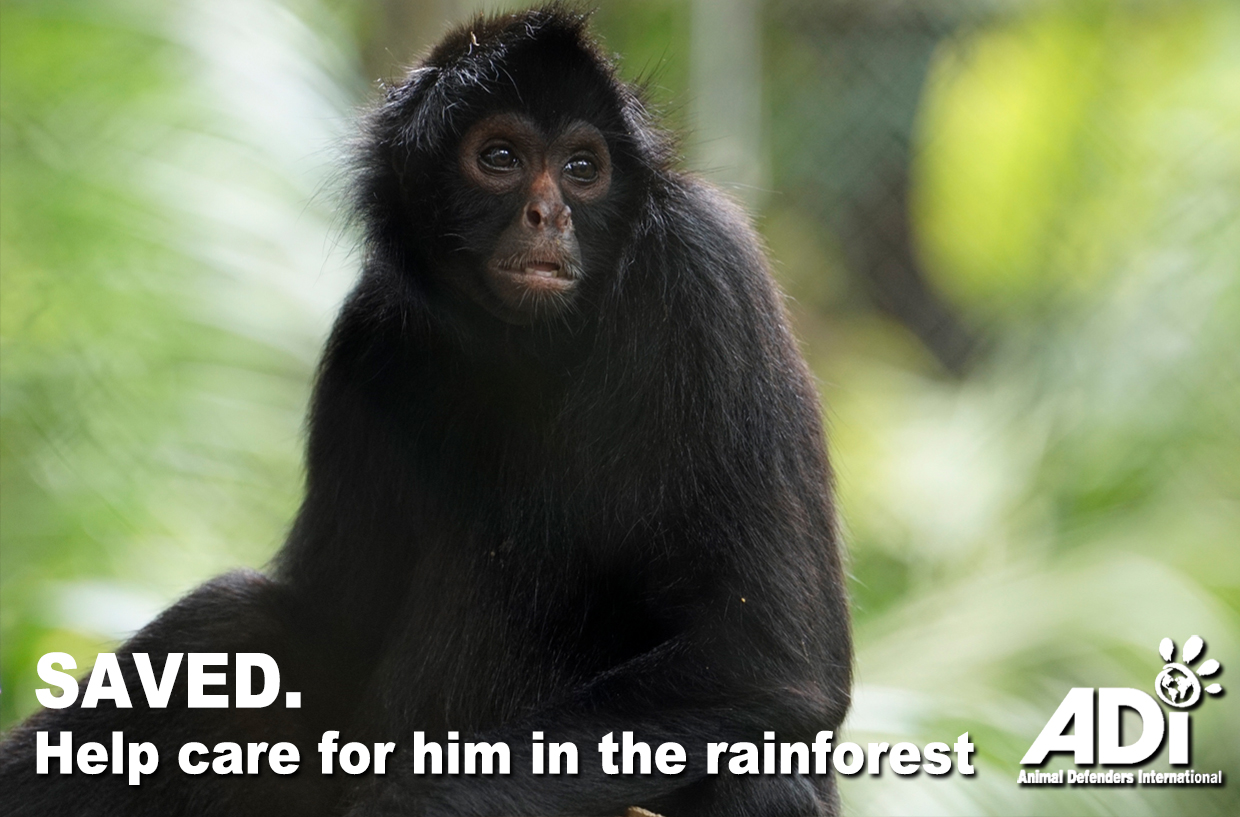
Spider monkey Pepe was chained in a circus for eight years until ADI rescued him. I’ll never forget the day he looked into our eyes as we cut him from his chains, nor the time we waited anxiously for him to come around after hours of dental surgery to repair his teeth, brutally broken by the circus, and deeply touching, when he was first reunited with his own kind, meeting the beautiful Valerie with her blue eyes, followed by many more spider monkeys; then his final hug to me, before bounding into his new forest habitat.
Pepe is 19 now, and a spider monkey can live to 40 years old. He will grow old in the forest with his own family of spider monkeys. That is how important this special rainforest place of safety is, for these monkeys.
The clock is ticking for us to get everything delivered for these vital repairs. Will you help raise the $10,000 / £8,000 we need?
Please make a commitment for the monkeys in our care and for the many more who have not yet been saved, with a donation today.
The hardest thing about rescuing animals from abuse is when it is time to say goodbye. When we save an animal, they dominate our thoughts, time and energy, a bond develops as we work to take them to freedom and a new life, but we have to acknowledge, both physically and psychologically, they cannot entirely escape their past. It is with great sadness I must report the passing of Jade, one of the young tigers from a Guatemala circus, who has passed away after an aggressive, fast-growing cancer was diagnosed. Our vet Dr Caldwell advised there was nothing to be done, and trying to treat it would cause more suffering. It was time to say goodbye.
Jade was the smallest of the group of young tigers we call the Spice Girls, but with a huge personality and quick mind which made her their leader. She was the live and soul of the group. Jade was the one who raced around and got her sisters playing, sometimes bounding up and getting them up, even when they were sleeping. For almost seven years, despite a terrible start in life in the circus in Guatemala, this small tiger had inspired us all with her boundless energy, lust for life, intelligence, sense of mischief and enthusiasm. She leaves a huge gap at the ADI Wildlife Sanctuary.
Now, through the sense of loss, we celebrate what precious years ADI supporters gave to dear Jade, and how very different her life would have been . The support for her and her family let them all know real joy.
The picture of Jade, above, was the day I first met her in the circus. It was a sweltering hot summer’s day in 2018, and the circus was refusing to comply with the Guatemalan Government’s ban on animal circuses. They were aggressive, shouting and blocking our way. Jade and her sister Luna shared a small bare cage, the size of a queen-sized bed. In the other cages were 13 other tigers and two lions (Tarzan and Tanya). Their lawyer blocked us that day, but over the course of the next five months, we kept pressing ahead and eventually, saved every one of them.
Jade and sister Luna were 18 months old at the time, and in our ADI Temporary Rescue Unit (TRU) in Guatemala, we united them with 6-month-old siblings from another litter, Sun and Moon. The group became known as ‘the Spice Girls’, because of their rambunctious behaviors. Our TRU in Guatemala was basic, but this was where the girls first ran and played on grass. Nobody who saw it will ever forget their first time playing in water. We had made a small pool for them – they raced in, water went everywhere, and within minutes it was full of mud, half the water splashed out and the whole area soaked. Everyone was laughing, enjoying their antics.
However, as always, the inbreeding, malnutrition and confinement of the circus would be harder to leave behind than the cages we had emptied. The members of the tiger family have all proved to be in the worst health of any animals we have rescued – 4 have already passed away due to neurological malfunctions (seizures) related to lifelong malnutrition and inbreeding. Jade was undersized and suffered spondylosis – the cause was similar to the ones who suffered seizures – malformed bones meant the nerves between her brain and spine were unable to function properly, in Jade, causing a goose-stepping walk.
The difference can be seen with Sun, Moon, Max, and Stripes – all rescued from the same circus but at just 6 months old, so they benefited from the enhanced ADI feeding regime, with extra vitamin and mineral supplements. They are all larger, strong, and not showing any neurological problems.
Jade had also lost her tail in the circus, with just a small stump left. This is a common injury in circuses when animals are chased through drop doors between cages and doors are dropped on their tails. Similarly, Tanya (from the same circus) has no fluffy tip to her tail. An ADI investigator filmed this happening in a British circus (before the ban).
In our grief at the loss of a family member, it is hard not to feel rage that circuses not only confine these animals in barren cages and take all the joy from their lives, but also break their bodies, causing lifelong damage. But they never broke Jade’s spirit.
Despite being the smallest of the Spice Girls, Jade was clearly the boss, and the one who energized the group to go out and play – she always raced to investigate everything first. It may have been sheer force of character, but it may also have been because she was so smart. Something she demonstrated to us with the puzzle game.
The ADIWS team built a play center for the residents, which was moved from habitat to habitat for different residents to play with and try to solve the puzzle (a ball inside a tunnel), while also enjoying the scent of other residents who had previously enjoyed the structure. The puzzle challenge was to get a small green ball around a corner and out of a small gap. While many residents at the ADIWS had pawed at it and tried to tug it out, Jade worked out the puzzle; she rolled in along the tunnel, around the corner, using her nose and paws, until the ball popped out.
When the family arrived at ADIWS, it was Jade who led them out. In part due to the spondylitis caused by the circus, and perhaps in part due to her character, she didn’t so much run, but rather bounced everywhere. She always appeared to be endlessly bouncing around the entire perimeter at high speed. It was magical when she first entered her big habitat at ADIWS when they arrived in 2020, just running and running and leaping on and off the big platform den, with such joy.
Jade always led the Spice Girls into the charge out of the houses and get the fun going. Classic Jade was also when seen she would be snoozing in the pool and then wake up, deciding it was time for everyone to get up, and race from one to another of the girls to rustle them up to play.
Jade was an inspiration to all, a bright star who brought joy and a smile to us all for seven wonderful years. A huge loss to her family and the whole Sanctuary. For seven years this small bundle of energy was a huge character at ADIWS.
Jade, you were loved and will be missed.
While we mourn Jade, just think of how very different her story would have been if ADI had not been on the ground for those long hot months in Guatemala, battling to empty the cages? Never forget how your support really does transform the lives of animals.
You may like to consider a donation in memory of Jade, to help care for her sisters, and to ensure that others like her get their chance to experience the life Jade enjoyed. Donate UK £, Euros, Rand | Donate US $, CA $